
Swimming Canada Officials Certification Pathway (Summary)
Swimming Canada recognizes five levels of officiating, each with specific training, clinics, and on-deck evaluation requirements. Officials progress at their own pace, and many requirements can be completed in any order.
As a new official, your first required course is the Introduction to Swimming Officiating Clinic. This course covers the basics of how a swim meet is run and provides the information needed to become a Timer, which is your first on-deck position.
The clinic is available as an e-learning module, making it easy to complete your initial training online. Instructor-led sessions are also available. Registration details for both options are provided in the Access Officials Courses tab. Please note that you only need to complete one option—either the e-learning module or the instructor-led clinic, not both.
Full details of the officiating progression through the Swim Canada Certification Pathway can be found here. A simplified summary of Level I and Level II is shown below. For more information please contact the Officials Coordinator.
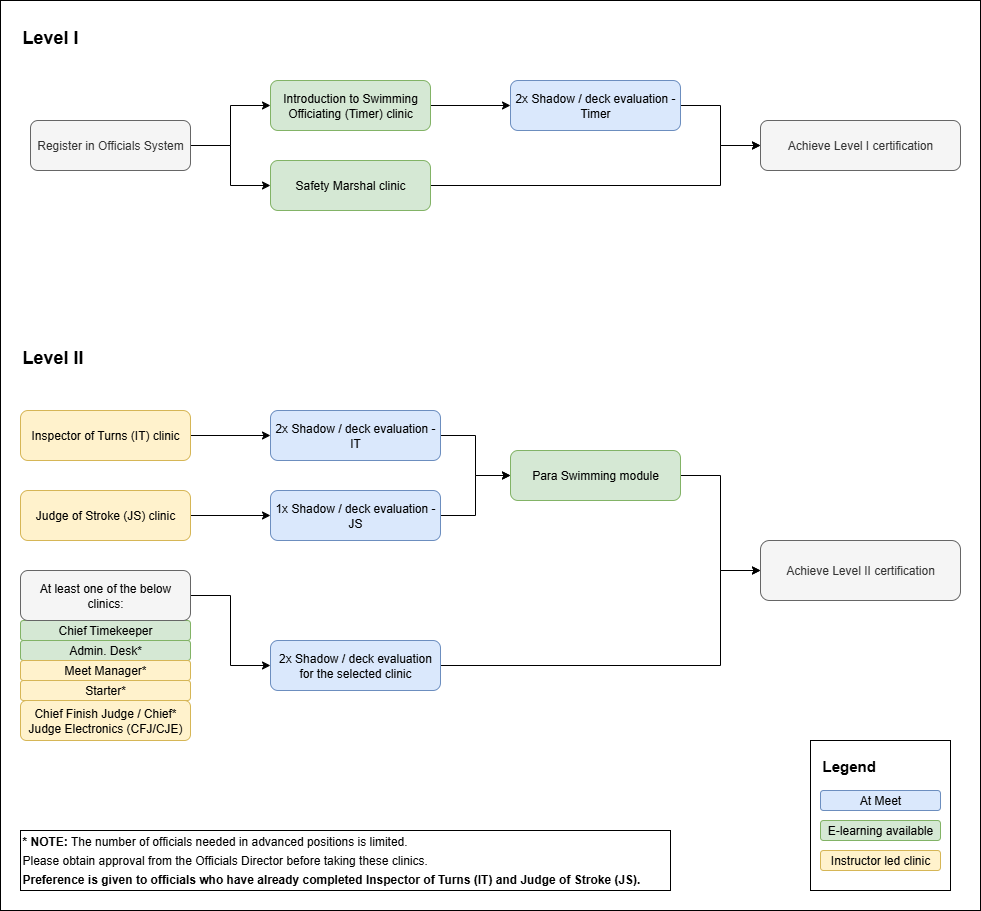
Description
a) Safety Marshal – monitoring deck, ensuring safety of athletes and area, enforcing warm up procedures (must have taken intro to swimming and safety marshal course)
b) Chaperone - monitoring kids on deck or in the waiting areas, herding them to the marshalling area
c) Timekeeper – ensuring accurate times are taken for athletes. (Must have taken the intro to swimming course and time keeper course)
d) Chief timekeeper – ensures all timing positions are filled and that timers are attentive and recording accurate times. Responsibilities include arranging substitutes, overseeing time collection, and understanding procedures such as official splits. The head timer serves as the primary troubleshooter for timing issues on deck, including lane errors or missed swims. Maintaining a calm and composed approach is essential.
e) Administration Desk** – The Administration Desk is responsible for ensuring the meet is properly set up and operational. This role involves working closely with the meet manager in advance, with two individuals typically sharing the workload in Region E.
Responsibilities include arriving early (when the facility opens) and remaining on-site throughout the meet, managing scratches and all relay changes, and ensuring the meet runs smoothly from an administrative perspective. This role often assumes duties typically handled by the meet manager.
Strong database proficiency is required, along with the ability to perform effectively in a high-pressure environment while managing real-time updates from coaches.
f) Chief Recorder/Scorer** – responsible for the final verification of times and preparation of results for referee approval. This includes entering disqualifications (DQs) and serving as the final checkpoint before sign-off.
Responsibilities also include adjusting times when necessary (e.g., using backup plunger times instead of touchpad results) and entering manual times if the touchpad system fails. Strong database proficiency and attention to detail are essential. This role is well suited for individuals who prefer to be involved on deck without active officiating.
g) Chief Judge Electronics** – The Chief Electronics is responsible for ensuring the accuracy and integrity of all incoming times and the proper operation of the timing system. While many facilities have a timing technician, this role requires the ability to identify and resolve issues independently when they arise.
Responsibilities include reviewing times in real time, validating or correcting results as needed, and ensuring the timing system supports the efficient flow of the meet. Strong technical proficiency, comfort with electronic systems, and the ability to remain calm under pressure are essential.
The Chief Electronics works closely with the Administration Desk and Chief Recorder as part of an integrated team to ensure accurate and timely results.
h) meet manager** - responsible for the overall planning, setup, and execution of the meet. This includes ensuring operations run smoothly, addressing technical issues, and delegating tasks effectively. Key duties include coordinating hospitality, organizing prizes, and supporting officials. Strong organizational skills and long-term planning are essential, including securing the home meet venue at least one year in advance. Having multiple meet managers is recommended to share responsibilities.
i) starter** - Responsible for initiating each race and determining the validity of each start. This includes making judgment calls on false starts, distinguishing between actual infractions and minor swimmer movement. Experience as an Inspector of Turns or Judge of Stroke is beneficial but not required.

